Media Requests | Candidate Profiles and Voter Guides
Today I responded to media requests from LWV of Winnebago County for their 411 Voter Guide Questionnaire and Post-Crescent. Here's what I submitted (below).
Vote411:
- What professional and community related experience do you have that will make you an asset on the Neenah School Board?
- I’ve worked in management, marketing, and analytics across training, consumer packaged goods, and life sciences. These roles have developed skills directly relevant to board service, including data analysis, clear organizational communication, and process-oriented decision-making. In the community, I’m the father of two NJSD students (1st and 6th grade), a member of the NEWvoices Choir, and a regular participant in library programs and events.
- What are the two most important issues facing the Neenah Joint School District? How do you propose these issues be addressed?
- The two most pressing issues are long-term financial sustainability and public understanding of school funding. These challenges are closely linked. Public schools rely on taxpayers and state and federal funding, yet revenue limits, voucher costs, and funding formulas are complex and difficult for the public to fully understand. Maybe I'm underestimating the public here, but I find these things complex for me to fully understand. That lack of clarity makes it harder for voters to make informed decisions about policies and referenda that affect the district.
- To address this, I would work to deeply understand the district’s funding challenges and help communicate them clearly to the community—how we got here, what constraints we face, and what options exist. Informed understanding is essential to building public trust and support.
- The Department of Public Instruction issues a report card to each school district every year. What is the value of this information? How should the board be using this data?
- The DPI report cards provide a clear, standardized snapshot of district performance and overall health, helping both the board and the public better understand how the district is doing. Beyond evaluating district administration, this data should be actively used in public communication.
- For example, recent report cards show a significant increase in students leaving NJSD for private schools—an important trend that directly affects district finances and the ability to maintain services and facilities. Using this data alongside financial information helps paint a fuller picture for the community and supports more informed public decision-making.
- Hover your cursor or tap parts of the bar charts below to see how many students were reported as enrolled in each of the schools in Neenah's reports. Note this chart is filtered for the City of Neenah and looks at enrollment reported by school across a few of the most recent years reports.
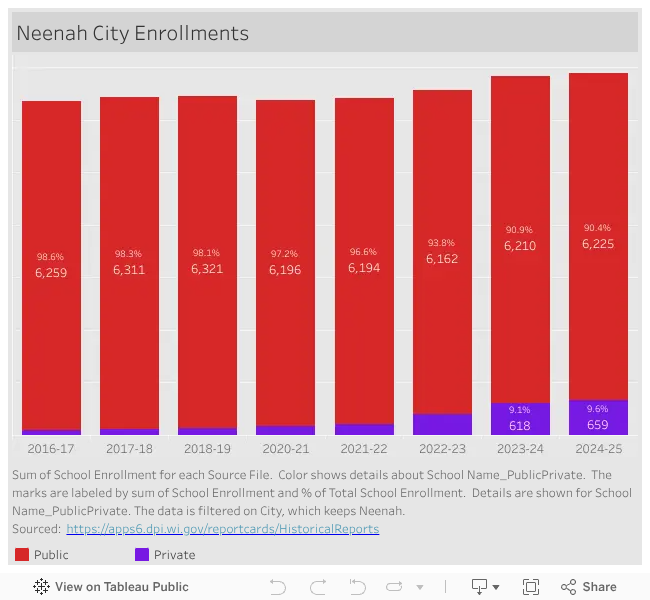
- While many taxpayers are aware that a portion of the money they pay in local property taxes is diverted to private voucher schools, most have no idea how much of their tax dollars are going to private voucher schools. Some districts in the state have been asking their municipalities to be transparent on tax bills, listing not only how much of a tax bill goes to education, but also to show how much goes to public education and how much to private/voucher schools. Would you advocate Neenah pursues this effort to be transparent with taxpayers?
- Yes, I would support that effort, but I don’t think it should stop there. I think it is reasonable for the taxpayer to say that the standards of education our tax money funds needs to be consistent. Beyond what proportion of the tax bill goes to private schools, tax payers should be able to check in on how their money was inevitably spent. As such, I believe it’s reasonable to expect fiscal transparency and accountability from private institutions receiving public tax dollars, including comparable financial reporting and academic standards. At a minimum, if public funds are used elsewhere, taxpayers should be confident those students are receiving an education that meets established expectations.
Post-Crescent:
- Why are you running for office?
- I feel very strongly that our community’s young people need to be highly literate to take over the reins of the world. This includes literacy in language that prepares them to be critical thinkers relying on facts and historicity, but also to be mathematically literate, capable of updating their priors and recognizing causation distinct from correlation. To that end, I am running for School Board to be a thoughtful contributor to the decisions aim at improving literacy outcomes.
- What do you think are the most important issues that Neenah schools face?
- The two most pressing issues are time and money! The public by and large doesn’t have the time to fully comprehend school district funding with sum certain vs sum sufficient allocations, revenue limits, voucher costs, and complex funding formulas. But if it comes to it, they’ll be expected to weigh in on a referendum that may have been instigated by those complexities. We need to bring the public along with informational fidelity about what drives our tax dollar’s spend.
- In light of rising costs and state aid not adjusting for inflation, many districts are facing tough financial decisions. How would you manage that issue locally?
- As a public servant, I would listen closely to constituents while working to deeply understand the district’s funding challenges. There may be programs, such as summer school, that help boost enrollment and improve funding in the short term. Over the long run, however, public education funding will require stronger public understanding and engagement. As a neighbor and school board member, I intend to support efforts to demystify these issues so the community is well informed and positioned to make thoughtful decisions.
- More local families are entering the Wisconsin Parental Choice Program, using public money for private school tuition. What is your view on the choice program and how it affects your district?
- The cost-per-student model for vouchers taken from the public school system is problematic. Each students’ educational cost is quite variable. When public schools have a mandate to teach the costliest, and private schools are free to deny those same students an education, then we cannot expect that a simple cost-per-student model of vouchers makes sense between the public and private schools. We are as likely to find the average student who has one ovary and a half scrotum as we are to find the average K-8 student that costs $10,877 to educate in the 2025-26 school year. As such, my view is that the voucher program puts undue financial pressure on our district which needs to be relieved.


Comments
Post a Comment